Google Ads does not work the same way it did two years ago. It barely works the same way it did six months ago.
On May 20, 2026, Google held Google Marketing Live and announced the most significant changes to its advertising platform since the service launched. Gemini AI is now embedded across Google Ads, Analytics, and Merchant Center. New ad formats live inside AI search responses. A new AI agent called Ask Advisor manages campaign recommendations across your entire Google account.
For Los Angeles businesses running Google Ads, this changes how campaigns are built, how they are managed, and what you should expect from whoever is running your account. Here is what actually changed and what to do with it.
What Google Marketing Live 2026 Actually Announced
The announcements from GML 2026 were not incremental. Google described them as “the agentic era” — a shift from tools that assist human decision-making to AI systems that make decisions autonomously within parameters you set.
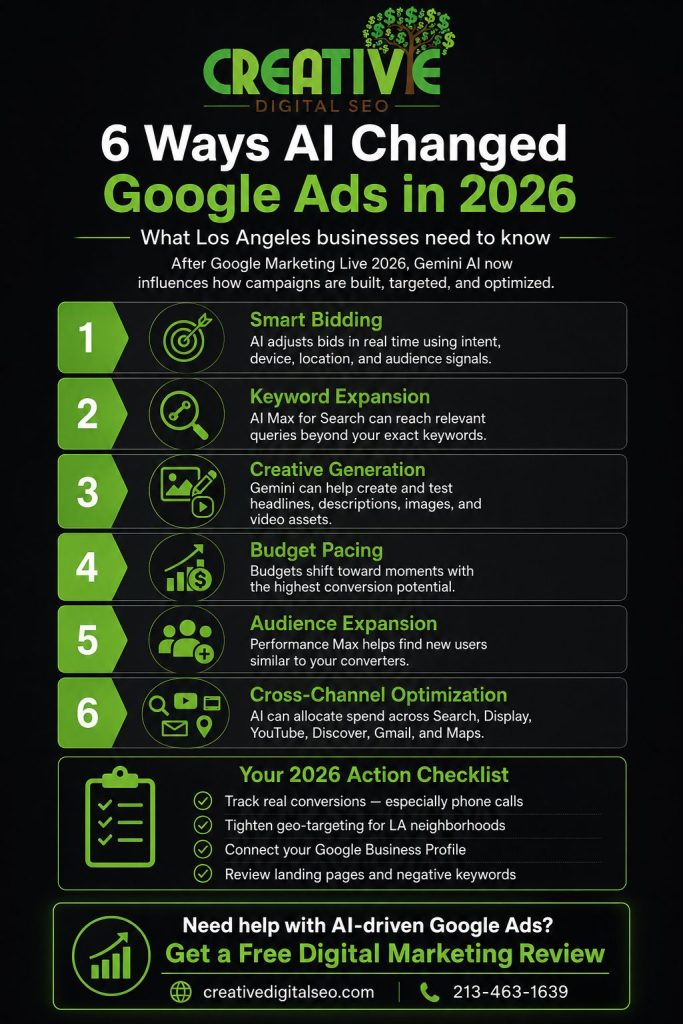
The key announcements that directly affect Los Angeles small and mid-size businesses running Google Ads: Ask Advisor, AI Max for Search general availability, Conversational Discovery ads inside AI Mode, and new AI-powered bidding and budget tools. Each one changes how your campaigns behave.
Understanding this shift matters because the relationship between Google Ads and SEO has fundamentally changed in the AI era. The two channels are now more intertwined than at any point in the past decade.
Ask Advisor: The AI That Now Runs Across Your Entire Google Account
Ask Advisor is a Gemini-powered AI agent that connects Google Ads, Google Analytics, Merchant Center, and Google Marketing Platform into one unified interface. It surfaces recommendations, flags performance issues, and suggests next steps across all your Google marketing products simultaneously.
For an LA business owner, this matters because Ask Advisor sees patterns across your entire account that a human manager checking each platform separately would miss. It connects ad performance to Analytics behavior to product feed data in real time. That is genuinely useful, when the inputs are correct.
The risk is that Ask Advisor recommends based on what Google measures, not necessarily what your business values. An LA home services company that values phone call leads over form fills needs to make sure its conversion tracking reflects that before Ask Advisor starts optimizing. Garbage in, garbage out, now at AI speed.
Ads Are Now Inside AI Responses — Not Just Beside Them
This is the structural change that most LA advertisers have not fully processed yet. Google announced two new ad formats at GML 2026 that live inside AI Mode responses — its conversational search experience powered by Gemini. These are not ads beside the answer. They are embedded in the answer itself.
The first format, Conversational Discovery ads, appears when a user is in a multi-turn AI conversation. The second, Highlighted Answers, generates an AI-written explainer about why your product or service matches the user’s specific situation, then ties it to your ad.
For Los Angeles service businesses — contractors, dental practices, med spas, law firms — this changes where your ad appears when someone searches conversationally. A homeowner asking “what kind of electrician do I need for a panel upgrade in Glendale” is now entering a search environment where your ad could appear inside the AI’s answer, not just as a sponsored link above it. That is a different creative challenge and a different conversion dynamic than traditional search ads.
What AI Now Controls in Your Google Ads Account: Six Things That Changed in 2026
Here is what the AI systems in Google Ads are now handling that human managers used to control manually:
- Bid amounts on every auction. Smart Bidding has been the default for years, but AI Max extends this further — Google’s AI now sets bids in real time based on conversion probability signals that include user context, device, location, time, query intent, and audience signals simultaneously.
- Keyword matching and expansion. AI Max for Search expands the reach of your campaigns to queries Google’s AI determines are relevant, beyond the keywords you selected. This can capture valuable traffic — or waste budget on irrelevant searches if your negative keyword lists and ad copy are not tight.
- Creative generation. Asset Studio now uses Gemini Omni to generate headlines, descriptions, images, and video variations from your brand inputs. The AI tests combinations at a scale no human team can match. Your job is briefing it correctly and reviewing what it produces.
- Budget pacing. New AI-powered pacing tools follow consumer demand signals rather than spreading budget evenly across the day. For LA businesses with clear peak inquiry hours, this can improve efficiency significantly — if your conversion data accurately reflects when your valuable leads actually come in.
- Audience expansion. Performance Max and AI Max both use look-alike modeling to reach users not actively searching for you but who match conversion patterns. For local LA service businesses, this needs tight geographic guardrails or budget can drift to users outside your actual service area.
- Cross-channel optimization. Performance Max runs across Search, Display, YouTube, Discover, Gmail, and Maps from one campaign. The AI allocates budget across channels based on where it sees conversion signals. Without proper tracking in place, it may favor channels that look good in platform data but do not actually drive the leads that close.
What This Specifically Means for a Los Angeles Small Business Running Google Ads
The LA market has some specific dynamics that affect how these AI changes play out. Google Ads CPCs in Los Angeles are above the national average across most service categories — legal, home services, medical, dental, and real estate all run significantly higher than national benchmarks. That makes wasted spend more painful here than in smaller markets.
AI-driven campaign types perform better when they have clean conversion data to learn from. An LA contractor who has been tracking “form submissions” as the primary conversion but whose actual sales come from phone calls is feeding the AI the wrong signal. Performance Max will optimize toward form fills while the calls — the ones that actually become jobs — are underweighted.
This is also why the combination of a properly structured Google Ads account with a strong local SEO foundation matters more now than before. The AI systems in Google Ads pull signals from your Google Business Profile, your website, and your conversion history simultaneously. A weak local presence undermines AI campaign performance even when the ad budget is healthy.
The LA Market Dynamic That Changes How You Should Think About AI Google Ads
Los Angeles has one of the most competitive Google Ads markets in the United States. Legal, home services, and medical practices here bid against each other at CPCs that would be considered absurd in Phoenix or Denver. That competitive pressure means the advertiser with better AI inputs — cleaner conversion data, stronger landing pages, better audience signals — wins by a wider margin than in lower-competition markets.
There is also a geographic complexity in LA that AI systems can struggle with. The city is not one market. A plumbing company serving the San Fernando Valley operates in a different competitive environment than one serving the Westside. A dentist in Glendale competes for different search queries than one in Beverly Hills, even when both cities are ten minutes apart. Performance Max and AI Max expand reach broadly, which can be excellent or disastrous depending on whether your geo-targeting guardrails match your actual service area.
The LA businesses we see winning with AI-driven Google Ads in 2026 are not the ones who handed everything to automation. They are the ones who gave the AI system clear boundaries — specific geographic targeting, accurate conversion events tied to revenue, and creative that speaks to their specific local market. The AI then executes within those parameters with scale and speed no manual campaign can match.
Do You Still Need a Google Ads Manager if AI Is Doing the Work?
This is the question every LA business owner running ads is thinking. The honest answer: yes, but the role has changed.
Manually adjusting bids keyword by keyword is largely irrelevant now. That work is done by the AI. What a skilled Google Ads manager does in 2026 is set the strategic parameters the AI operates within — conversion tracking accuracy, geographic boundaries, audience exclusions, creative quality, budget allocation across campaign types, and interpreting what the AI reports versus what is actually driving business results.
The value of a Google Ads management partner in Los Angeles is not in doing what the AI already does automatically. It is in making sure the AI has accurate inputs, checking its outputs against real business results, and making the strategic calls the AI cannot make — like whether a campaign is generating the right type of leads even when the volume looks good on paper.
An AI that optimizes for 50 form submissions a month is doing its job. A manager who notices that only 8 of those form fills are from viable leads — and adjusts the conversion goal accordingly — is doing theirs.
Frequently Asked Questions
Q: What is AI Max for Google Ads and does it replace regular search campaigns?
AI Max is Google’s latest AI-powered campaign type that expands your reach across Search queries beyond your selected keywords, using Gemini to match your ads to relevant intent. It does not fully replace traditional search campaigns — most experienced managers in 2026 run a mix of AI Max, Performance Max, and standard search campaigns depending on the goal and budget.
Q: What is Ask Advisor in Google Ads?
Ask Advisor is a Gemini-powered AI assistant announced at Google Marketing Live 2026 that connects Google Ads, Google Analytics, Merchant Center, and Google Marketing Platform into one unified interface. It surfaces recommendations across your entire Google marketing stack, identifies optimization opportunities, and suggests next steps. It is available in beta for US advertisers and rolling out through 2026.
Q: Should a Los Angeles small business use Performance Max or Search campaigns?
It depends on your data quality and business type. Performance Max works best when you have clean conversion data, strong creative assets, and a clear customer profile. For LA service businesses with limited conversion history or phone-call-heavy lead flows, a standard search campaign with Smart Bidding is often more predictable. Most experienced LA Google Ads managers run both and let the data determine where budget should shift.
Q: How do the new AI ad formats inside Google AI Mode affect my campaigns?
The new Conversational Discovery and Highlighted Answers formats appear inside Google AI Mode search responses. Advertisers do not set these up separately — eligibility comes from your existing AI Max or Performance Max campaigns when Google determines your ad is relevant to the conversational context. The immediate action: ensure your product and service pages have detailed, specific content so Gemini can generate accurate Highlighted Answers from them.
Q: How do I make sure AI-driven Google Ads campaigns are spending budget in the right LA neighborhoods?
Set explicit geographic targeting at the campaign level and use location bid adjustments to increase or decrease bids by area. Performance Max and AI Max expand reach by default, so adding negative geographic targets for areas outside your service zone is critical. For an LA home services company serving specific zip codes, “Los Angeles” as a location target is too broad — set your actual service radius.
Ready to Get More From Google Ads in Los Angeles?
The AI changes from Google Marketing Live 2026 are not something to wait on. Advertisers who adapt their campaign structure, conversion tracking, and creative strategy to work with the new AI systems will outperform those running the same setup they had in 2024.
Creative Digital SEO manages Google Ads campaigns for businesses across Los Angeles, Burbank, Glendale, and the San Fernando Valley. If you want to know whether your current campaigns are set up to take advantage of AI Max, Performance Max, and the new bidding tools, or if you’re starting fresh and want to do it right from the start, contact us here for a straightforward account review.
The ad landscape in LA changed significantly in May 2026. The businesses acting on that now are the ones with an advantage heading into Q4.